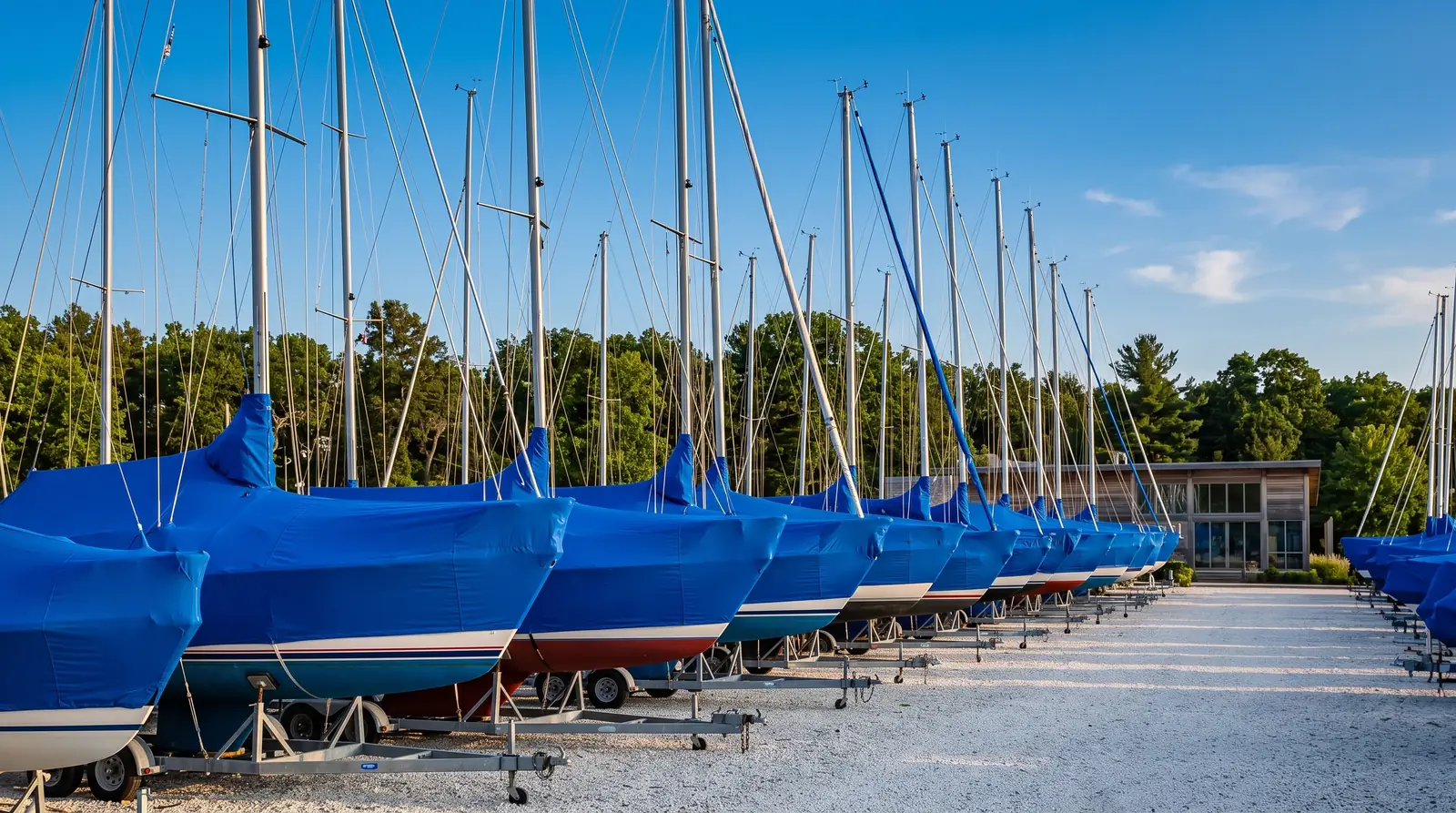
Wrapping a sailboat for winter brings one question powerboat owners never have to think about: does the mast stay up or come down? The answer changes how the wrap is built, what it costs and how well the boat comes through a Georgian Bay winter. Here’s how sailors around Midland, Penetanguishene and Collingwood can weigh it up.
The short answer
For most sailboats stored outside on the hard, unstepping the mast and wrapping the boat with the mast down is the more common and more cautious choice. Mast-up storage can work, and it has real advantages, but it depends on the boat, the cradle, the yard and how exposed the storage spot is.
Your marina or storage yard may make the decision for you. Many yards have their own rules about mast-up storage, so ask before you plan anything else.
Mast down: how it works
The mast is unstepped, usually with a crane, at haul-out. It’s then stored on a mast rack, in a shed or on the boat itself, supported on deck by padded stands.
When the mast stays on the boat, it often becomes the backbone of the wrap. The wrapper builds a frame using the mast as a ridge pole, then shrinks the plastic over it. That creates a pitched roof that sheds snow.
Pros
- Less wind load. No tall mast catching winter gales means less strain on the cradle and stands.
- A chance to inspect the rig. With the mast on the ground, you can check the standing rigging, spreaders, masthead fittings, lights and wiring up close.
- A ready-made ridge pole. If the mast lies on deck, the wrap has a strong spine.
- Fewer yard restrictions. Most yards are fine with mast-down storage.
Cons
- Crane costs and scheduling. Unstepping and re-stepping usually means two crane lifts, and those slots fill up in fall and spring.
- More work at both ends. Rigging has to be disconnected, labelled and re-tuned in spring.
- Storage space. A mast stored off the boat needs a rack or shed space.
Mast up: how it works
The boat is hauled and blocked or cradled with the mast still stepped. The wrap is built around the mast, with the plastic sealed and taped where it meets the spar. The rest of the frame works much like any other wrap.
Pros
- No crane time. You save the cost and scheduling hassle of two crane lifts.
- Faster spring launch. The rig stays tuned, so you can get on the water sooner.
- Less handling of the mast. Fewer chances to damage the spar, wiring or fittings.
Cons
- More wind load. A stepped mast catches wind all winter. That puts real strain on the cradle, stands and hull. A well-matched cradle and good blocking matter even more.
- Harder to seal. The joint between the wrap and the mast is a weak point. Wind can flex the mast and work the seal loose, letting water and snow in.
- Rigging stays exposed. Standing rigging, halyards and fittings sit through the winter without a close inspection.
- Yard rules. Some yards don’t allow mast-up storage at all, or only in certain spots or with certain cradles.
- Higher cost per foot. Mast-up wraps take more time and material.
Side by side
| Mast down | Mast up | |
|---|---|---|
| Wind load in storage | Low | High |
| Crane lifts needed | Two (out and in) | None |
| Rig inspection | Easy, at ground level | Hard, needs a climb |
| Wrap seal | Simple | Weak point at the mast |
| Spring launch | Slower, rig needs tuning | Faster |
| Yard acceptance | Almost always | Varies |
What it typically costs
Sailboat shrink wrap typically runs $12–$25 per foot, plus about $2–$3 per foot if the mast stays up. Smaller boats sit at the low end. Access doors, vents and other extras usually cost more. These are typical ranges, not quotes, and crane fees for unstepping are separate.
For a broader look at covers, including tarps and canvas, see shrink wrap vs tarp vs canvas.
Prep before the wrap goes on
Whichever way you go, the boat should be ready before anyone starts building a frame.
- Winterize the engine and water systems. This comes first, every time. The boat winterizing checklist covers outboards, sterndrives and inboards.
- Remove sails and canvas. Take off the main, headsail, dodger and bimini. Store them clean and dry indoors.
- Clean and dry the deck and cockpit. Moisture trapped under a wrap leads to mildew.
- Secure loose lines. Lash halyards away from the mast so they don’t slap all winter, or run messengers if you’ve pulled them.
- Check the cradle and stands. Make sure they suit the boat and are properly placed and chained. This matters even more with the mast up.
- Ask for vents and a door. Vents help prevent condensation. A zippered door lets you check on the boat without cutting the wrap.
The sailboat shrink wrap page explains what a typical sailboat wrap includes.
Local things worth knowing
- Midland: with marinas around the downtown harbour and the surrounding bays, many sailboats are stored in yards together. If yours is part of a group of boats, a marina and yard wrap can make scheduling simpler. See the Midland area page.
- Penetanguishene: Penetang Bay has a strong sailing culture and busy marinas. Book crane time early if you’re unstepping, since haul-out weeks are crowded.
- Collingwood: boats stored near the harbour can see strong winds off Nottawasaga Bay. That is a good reason to think carefully before leaving the mast up.
Timing
Haul-out and winterizing come first in October. Wrapping usually follows from late October into November, before the first heavy snow. If you plan to unstep the mast, line up the crane and the wrap together so the boat isn’t left sitting uncovered for long.
Quick answers
Is it OK to store a sailboat with the mast up over winter?
It can be, if the yard allows it, the cradle is well matched and the boat is properly blocked. Mast-up storage puts more wind load on the boat, and the wrap is harder to seal around the mast.
Does mast-up shrink wrap cost more?
Usually, yes. Typical sailboat wrapping runs $12–$25 per foot, plus about $2–$3 per foot if the mast stays up. Crane fees for unstepping, if you go mast down, are extra.
Can the mast be used as a ridge pole for the wrap?
Yes. When the mast is unstepped and stored on deck on padded supports, wrappers often use it as the spine of the frame, which gives a strong, pitched roof that sheds snow.
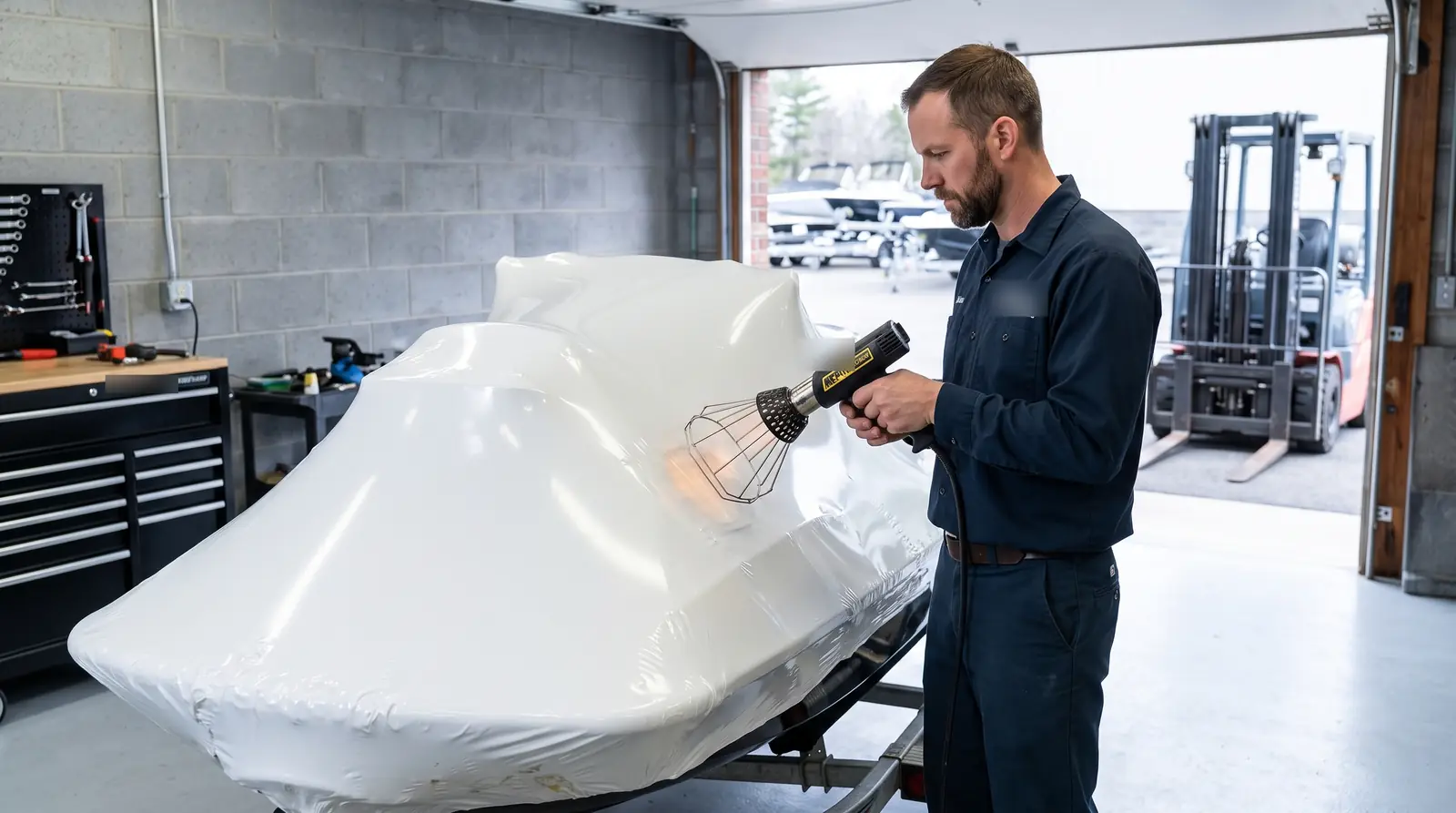 Mobile shrink wrapping
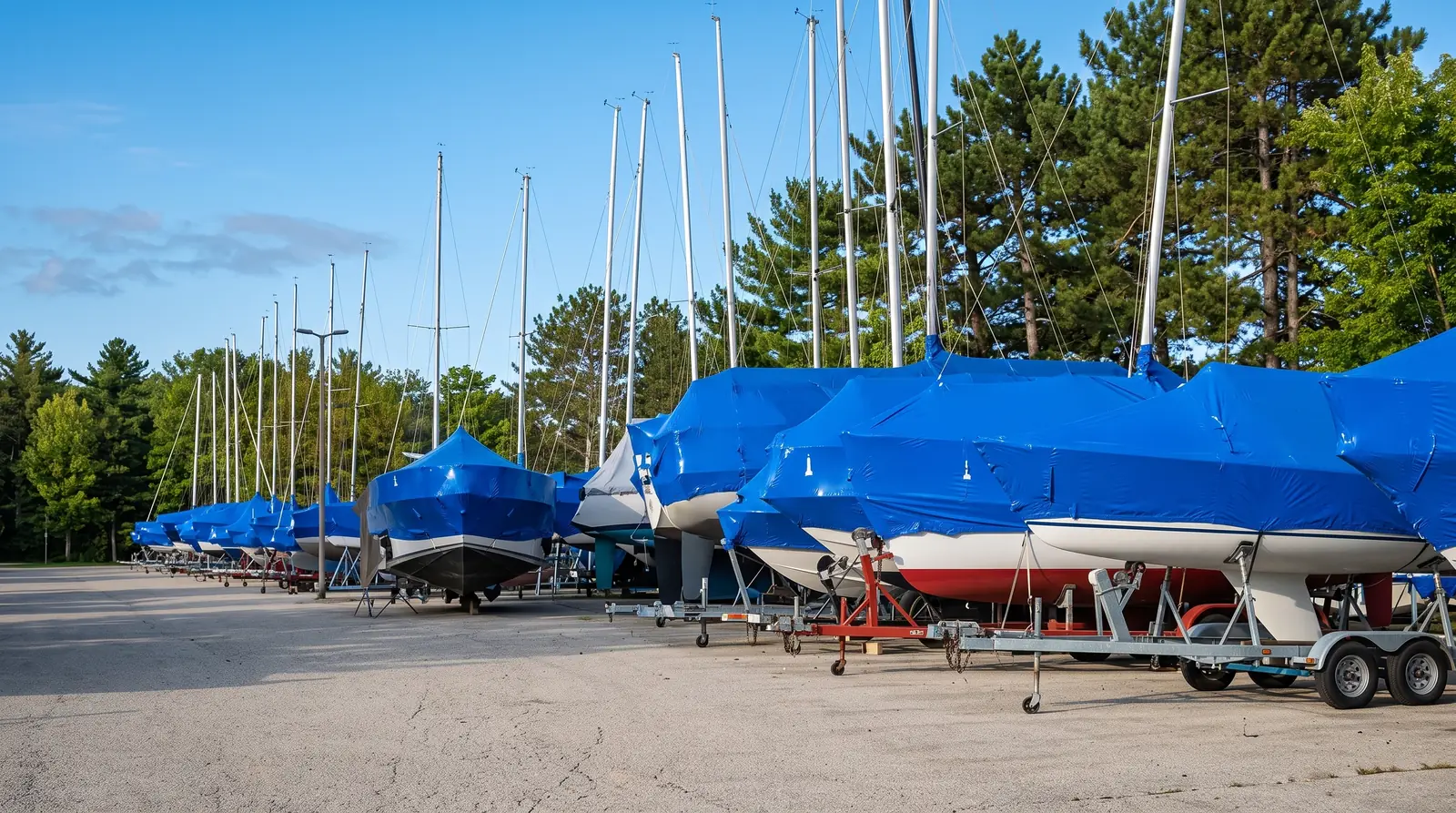 Marina & yard wraps